
Description
Psychedelics are often said to transform the mind by increasing “entropy”: loosening rigid patterns in the brain and opening consciousness to new possibilities. The Templeton-funded Mystical Entropy project, based in the PRSM Lab of the Cognitive Psychology Unit at Leiden University, asked whether the world’s mystical and contemplative traditions could help us understand this process. Many of these traditions have developed practices for systematically loosening, reorganizing and transforming the mind. By studying those practices from the inside, we hoped to uncover distinctions that could inform the neuroscience of psychedelics. Our initial investigations led us to Kuṇḍalinī Yoga and, in particular, its system of chakra meditations, in which different practices are used to induce distinct states and transformations of consciousness. When we began comparing these states with psychedelics, something remarkable happened.
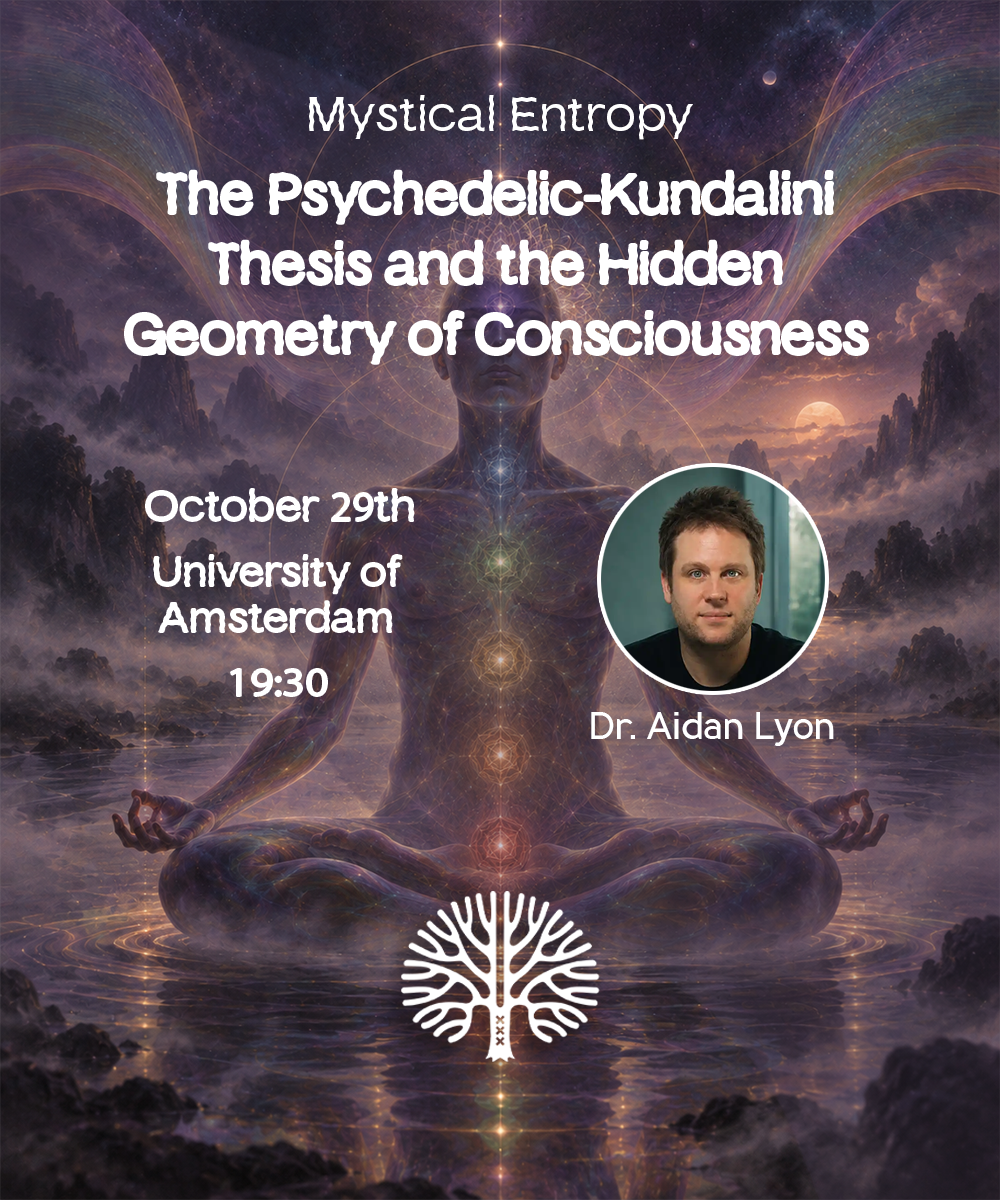
From these comparisons emerged the Psychedelic–Kundalinī Thesis: a striking three-part correspondence between chakra states and psychoactive drugs. Maṇipūra (solar plexus) resembled stimulants, Anāhata (heart) resembled MDMA, and Ājñā (third eye) resembled classic psychedelics. We first moved from first-person experience to third-person phenomenology, testing the prediction against independent reports of drug experiences, which reproduced the same 3×3 pattern. We then moved from phenomenology to neuroscience, asking whether the same structure could be recovered independently in neuroimaging data. We collected the world’s first chakra-meditation fMRI dataset and compared it with a pharmacological neuroimaging corpus spanning seven cohorts, eight compounds and 308 drug–baseline observations. Once again, the same 3×3 correspondence emerged: Maṇipūra aligned most strongly with stimulants, Anāhata with MDMA, and Ājñā with psychedelics. The result is a striking neurophenomenological convergence: a structure first discovered through contemplative experience reappearing across phenomenology and neurophysiology.
If this pattern continues to hold across larger studies, a map developed through centuries of contemplative practice may have captured something remarkably general about the ways human consciousness can change. The implications could also be profoundly practical. It could help make psychedelic-assisted therapy more precise: matching different interventions to different people and different kinds of transformation, and developing targeted contemplative practices for preparation and integration. It could give us more actionable ways of carrying extraordinary experiences into ordinary life, while helping us recognize when those transformations are becoming destabilising and how to respond. In the longer term, it points toward precision psychiatry organised around the transformations people need—and a science capable of navigating those transformations deliberately.
About Dr. Aidan Lyon
Aidan Lyon is a mathematical philosopher, psychologist and consciousness researcher, and the founder and director of the Center for Psychedelic Space in Amsterdam. The Center is an independent research organisation developing a science and practice of navigating transformations of consciousness, bringing together psychedelic research, contemplative traditions, psychology, neuroscience and philosophy. His current research focuses on how different states and transformations of consciousness can be mapped across these domains, and how those maps might eventually be used to navigate them more deliberately.
Aidan was Principal Investigator of the John Templeton Foundation-funded Mystical Entropy project in the Cognitive Psychology Unit at Leiden University, where his research increasingly brought contemplative practice into dialogue with psychedelic neuroscience. He is the author of Psychedelic Experience: Revealing the Mind (Oxford University Press, 2023), which examines what psychedelic experiences can reveal about the mind and how we should evaluate the knowledge they appear to provide. His recent work combines first-person contemplative research with phenomenology, computational methods and neuroimaging, including the development of the Psychedelic–Kuṇḍalinī Thesis and, with Anand Vaidya, the PEACE framework for contemplative research.
His academic roots are in mathematics, philosophy and the foundations of probability. He holds a PhD in Philosophy from the Australian National University and a BSc in Mathematics from the University of Queensland, where he received the University Medal. He was an Assistant Professor at the University of Maryland and an Alexander von Humboldt Fellow at LMU Munich, and has held research appointments at universities in Australia, the United States, Germany and the Netherlands. He is currently an External Member of the Munich Center for Mathematical Philosophy.
Beyond academia, Aidan has worked across artificial intelligence, machine learning, forecasting, risk and decision-making under uncertainty, including work with governments, technology companies and institutional investors. Across these different fields, his work has been driven by a recurring question: how can we study forms of consciousness and intelligence that challenge our established ways of knowing while remaining rigorous about what we can actually claim? At the Center for Psychedelic Space, these strands now come together in a broader effort to develop better ways of understanding – and ultimately navigating – the possibilities of the human mind.
Location
University of Amsterdam, Roeterseiland Campus. Room number will be shared to those who have registered.
Registration
This talk is free, but registration is required. Use the booking form below to register.