
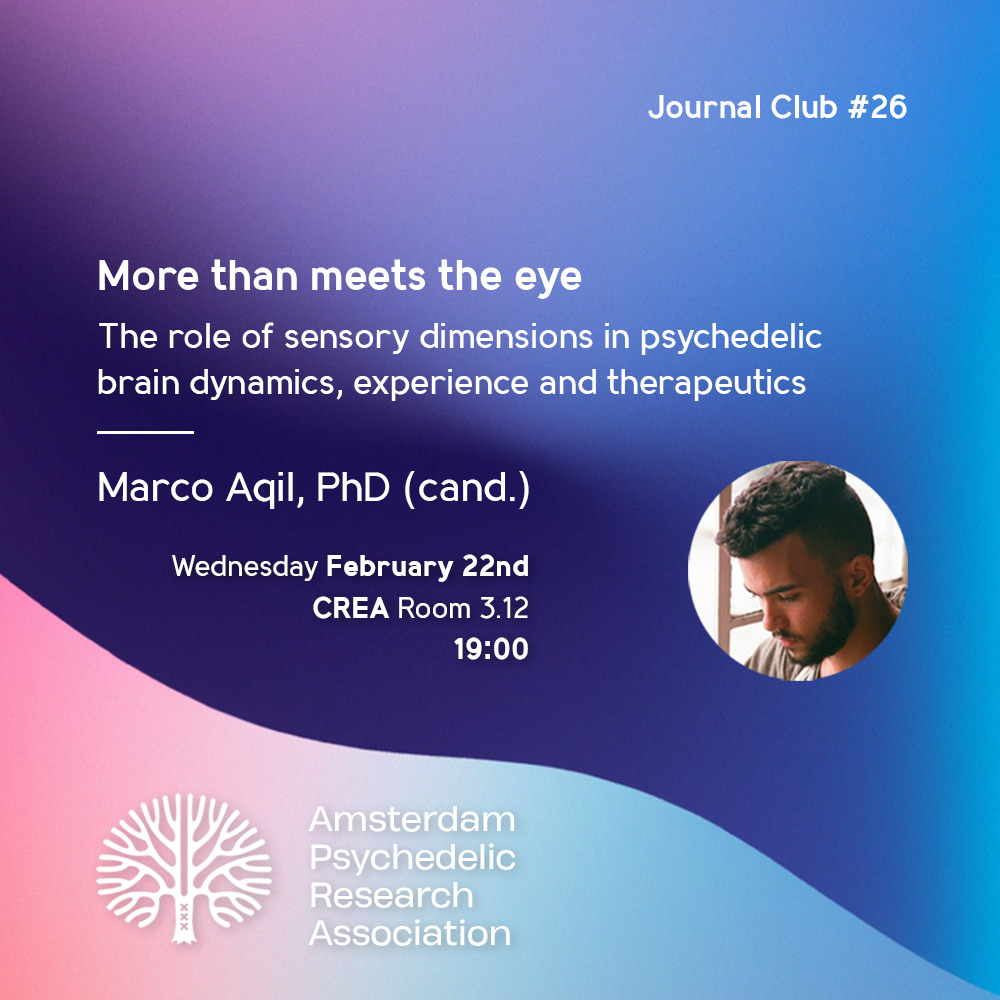
For our next Journal Club our very own APRA founder Marco Aqil will present his recent publication on the role of low-level sensory processes in the context of psychedelic effects.
See below for the abstract and link to the article.
The event will take place at CREA Amsterdam, room 3.12.
As always, there is room for drinks and discussion afterward!
As always, there is room for drinks and discussion afterward!
Speaker bio
Marco Aqil is a PhD candidate at the Spinoza Centre for Neuroimaging (Amsterdam, NL) and the founder of the Amsterdam Psychedelic Research Association (APRA).
Marco Aqil is a PhD candidate at the Spinoza Centre for Neuroimaging (Amsterdam, NL) and the founder of the Amsterdam Psychedelic Research Association (APRA).
Abstract
Psychedelics are undergoing a major resurgence of scientific and clinical interest. While multiple theories and frameworks have been proposed, there is yet no universal agreement on the mechanisms underlying the complex effects of psychedelics on subjective experience and brain dynamics, nor their therapeutic benefits. Despite being prominent in psychedelic phenomenology and distinct from those elicited by other classes of hallucinogens, the effects of psychedelics on low-level sensory – particularly visual – dimensions of experience, and corresponding brain dynamics, have often been disregarded by contemporary research as ‘epiphenomenal byproducts’. Here, we review available evidence from neuroimaging, pharmacology, questionnaires, and clinical studies; we propose extensions to existing models, provide testable hypotheses for the potential therapeutic roles of psychedelic-induced visual hallucinations, and simulations of visual phenomena relying on low-level cortical dynamics. In sum, we show that psychedelic-induced alterations in low-level sensory dimensions 1) are unlikely to be entirely causally reconducible to high-level alterations, but rather co-occur with them in a dialogical interplay, and 2) are likely to play a causally relevant role in determining high-level alterations and therapeutic outcomes. We conclude that reevaluating the currently underappreciated role of sensory dimensions in psychedelic states will be highly valuable for neuroscience and clinical practice, and that integrating low-level and domain-specific aspects of psychedelic effects into existing nonspecific models is a necessary step to further understand how these substances effect both acute and long-term change in the human brain.
Psychedelics are undergoing a major resurgence of scientific and clinical interest. While multiple theories and frameworks have been proposed, there is yet no universal agreement on the mechanisms underlying the complex effects of psychedelics on subjective experience and brain dynamics, nor their therapeutic benefits. Despite being prominent in psychedelic phenomenology and distinct from those elicited by other classes of hallucinogens, the effects of psychedelics on low-level sensory – particularly visual – dimensions of experience, and corresponding brain dynamics, have often been disregarded by contemporary research as ‘epiphenomenal byproducts’. Here, we review available evidence from neuroimaging, pharmacology, questionnaires, and clinical studies; we propose extensions to existing models, provide testable hypotheses for the potential therapeutic roles of psychedelic-induced visual hallucinations, and simulations of visual phenomena relying on low-level cortical dynamics. In sum, we show that psychedelic-induced alterations in low-level sensory dimensions 1) are unlikely to be entirely causally reconducible to high-level alterations, but rather co-occur with them in a dialogical interplay, and 2) are likely to play a causally relevant role in determining high-level alterations and therapeutic outcomes. We conclude that reevaluating the currently underappreciated role of sensory dimensions in psychedelic states will be highly valuable for neuroscience and clinical practice, and that integrating low-level and domain-specific aspects of psychedelic effects into existing nonspecific models is a necessary step to further understand how these substances effect both acute and long-term change in the human brain.
Find the full article here:
https://www.sciencedirect.com/…/pii/S0028390822003598…
https://www.sciencedirect.com/…/pii/S0028390822003598…
This is a free event for APRA members.
Consider supporting APRA by becoming a member. Membership has several benefits (free events, monthly newsletter), but most importantly, since the activities of APRA are determined by its members, it allows you to become directly engaged with the life and future of the association.
Check out:
https://apra.science/becomeamember
Consider supporting APRA by becoming a member. Membership has several benefits (free events, monthly newsletter), but most importantly, since the activities of APRA are determined by its members, it allows you to become directly engaged with the life and future of the association.
Check out:
https://apra.science/becomeamember
Bookings
Bookings are closed for this event.